

Don't Fear The OpEx
AI and The Age of Productivity
When was the last time you gave or got a raise at the cost of inflation?
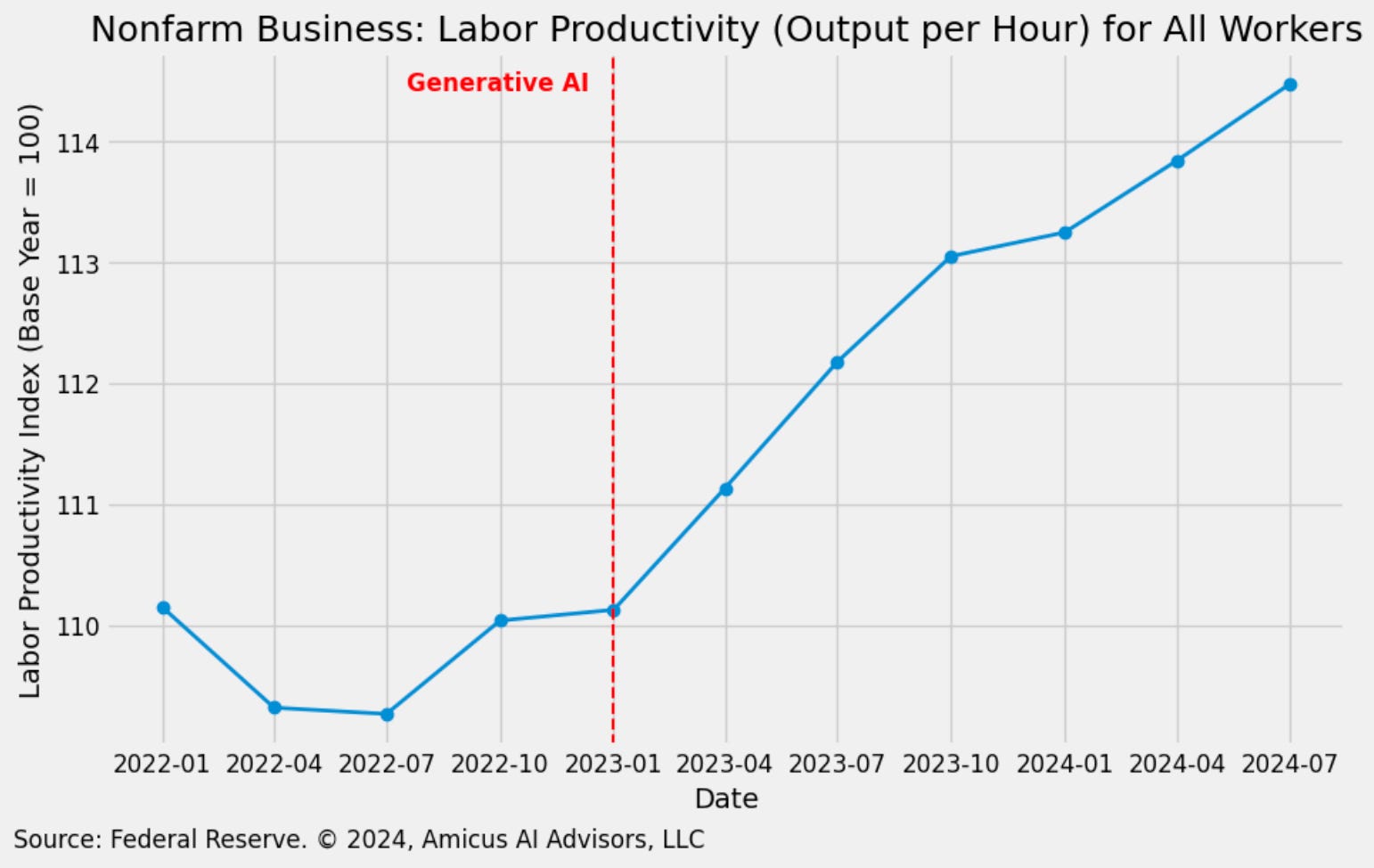
Fed Chair Powell expressed surprise at the continuing strength of domestic productivity at last Thursday’s rate cut presser.
“If we see productivity more sustainable at these high levels, then that would sustain higher wage gain.”
– Chairman of the Federal Reserve, Jerome Powell
In Q2 2024, US labor productivity surged by 2.3%, surpassing expectations.
Nobel Prize winners Daron Acemoglu and Simon Johnson gave the historical context: “US median real wages (hourly compensation) grew at above 2.5 percent per year between 1949 and 1973. Then from 1980 onward, median wages all but stopped growing.”
Economist Robert Solow put it another way – “the computer age was everywhere except for the productivity statistics.”
The fact is computers weren’t up to many routine intellectual tasks.
That is until now.
Programming is difficult for the majority of even well-educated workers.
Generative AI bridges the gap, meaning less time for white-collar tasks.
Higher productivity means that wages can increase.
Again from Acemoglu and Johnson, “as a result of the broadly balanced investments in automation and new tasks in the 1950s and 1960s… labor share of income in manufacturing remained broadly constant, hovering close to 80 percent between 1950 and the early 1980s”.
That was a golden age in America.
Capital in balance with labor.
Companies leading with AI, using new tasks in step with new capability, are bringing a new era of common prosperity.